
Describe the change in drying results
Before requesting dryer assessment, distinguish laundry remaining moist from a programme seeming longer than usual. Report the fabrics, chosen programme and whether the load resembled earlier loads. Existing observations are enough; do not create comparison tests. RMAN inspects the appliance, explains findings and proposed work, and gives a firm quote after assessment before repair is agreed.
If it is unclear whether the programme finished or stopped, say so. Note whether every item was moist or only certain pieces. These details describe the complaint without diagnosing a part.
Use the load as context, not proof
Results can differ with fabric types and how items are combined, but fabric alone does not establish a fault. Report the actual load and whether it followed the manual. Do not change loads to prove a theory, and do not apply a universal load allowance across models or programmes.
Check garment care information and the dryer manual. An unsuitable or uncertain item should not become a test load. Describe tangling observed previously without reaching into a moving appliance or rearranging laundry during operation.
The selected programme belongs in the report
The selected programme and its meaning for your model are useful details. Consult the manual with the dryer off rather than pressing unfamiliar functions to force a result. Similar names do not make programmes identical across appliances.
Explain whether the selection is known or uncertain, particularly where several people use the dryer. Describe any previous message or changed display behavior in plain language without translating it into a failed-part diagnosis. Report what the appliance was doing when the change appeared.
Laundry moisture before transfer matters
Laundry that leaves the washer wetter than previously is a separate observation worth reporting. It does not prove that the washer explains everything or clear the dryer of concern. Describe the end of washing and spinning without running another cycle for comparison.
A distinct spin problem can be discussed through washing machine service. The washer care guide provides related context, not a diagnosis of current moisture. Keep the before-transfer condition separate from the dryer's result so assessment can consider both accurately.
Lint filters and safe observation limits
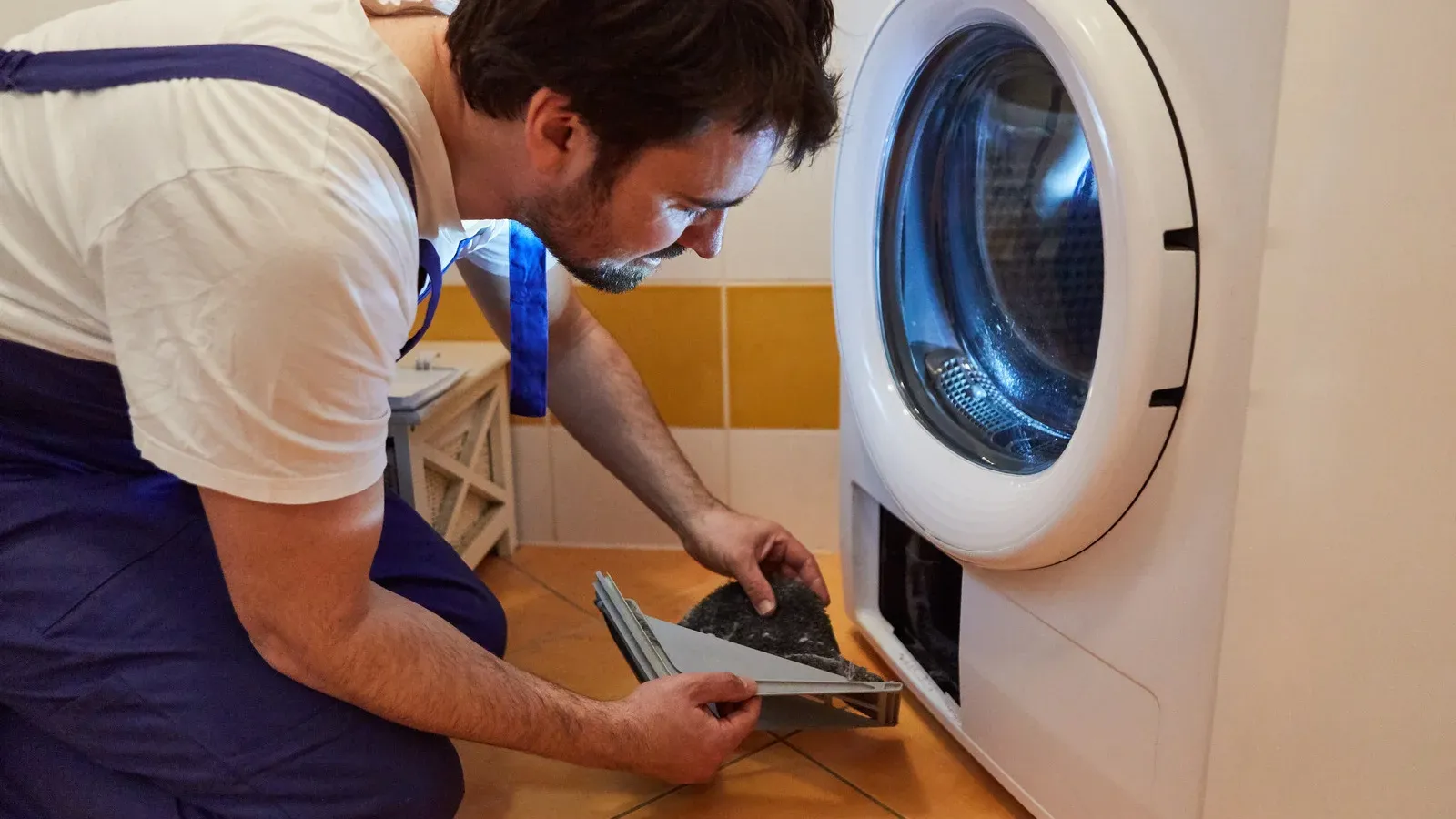
Follow only the manual's care for an owner-accessible lint filter with the appliance off, safely disconnected and cool. Do not reach behind the filter, use an object to enter concealed areas or run the dryer with a care part removed. Stop if refitting is unclear.
Visible lint does not establish the whole cause, and a clear filter does not rule out a fault. Report what was observed and done. Smoke, burning smell, sparking or unusual heat ends checks: stop use and call a technician without touching the appliance to confirm heat.
Dryer type changes the relevant questions
Airflow, water collection and owner care differ by dryer type and model. Do not transfer a vented design's care to a condenser appliance or assume another heat pump model has the same access. The dryer maintenance by type guide helps frame the right questions; your own manual sets owner-care limits.
Report known type and changes around the dryer without moving it or altering installation. Water near electrical equipment means stopping use and calling a technician instead of tracing its source.
An observation and response checklist
Observation: laundry moisture has changed. Report its condition before transfer and after the programme actually used; assessment must distinguish load, selection and appliance concerns.
Observation: lint is visible on the owner-accessible filter. Follow only permitted manual care while safely disconnected. Leave inaccessible areas and unexplained difficulty to a technician.
Observation: smoke, burning smell, sparks or unusual heat. Stop use and call. The dryer warning-sign guide offers context rather than a request to search for those signs.
Observation: programme or load details are unknown. Preserve the uncertainty; the checklist does not require another experiment.
Ask how the findings explain the complaint
Ask how the findings explain the reported drying change and what work is proposed. Establish whether washer observations or programme selection are relevant to the same concern or separate matters. Continued drum movement does not explain all performance, and another owner's part replacement is not a diagnosis for yours.
Before approval, understand what is included. At handover, ask what was completed and how the complaint was reviewed. Retain that explanation and any remaining observation rather than performing a risky follow-up test or assuming a universal performance improvement.